

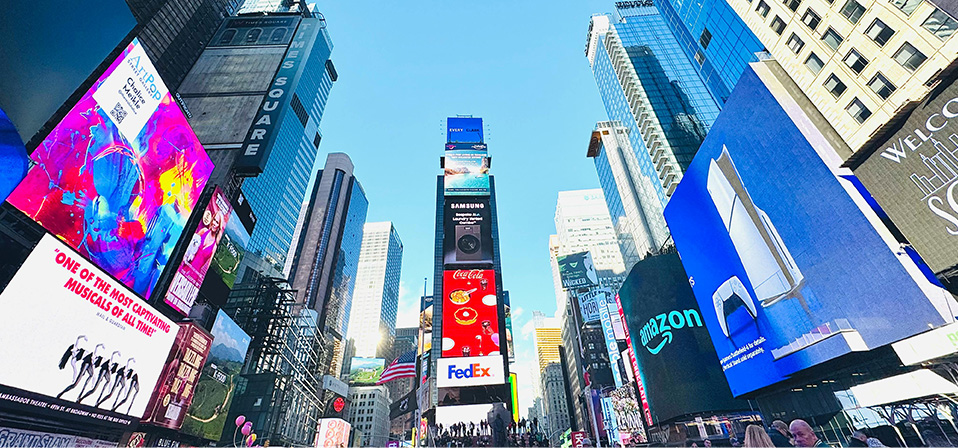
In an era defined by the global digital tide, we have become accustomed to measuring everything through the lens of traffic, clicks, and conversion rates. Algorithms dictate our attention, and screens have become our primary window to the world. Yet, amidst this "all-digital" frenzy, a supposedly "old-school" medium—Out-of-Home advertising—is quietly undergoing a sophisticated renaissance. Far from being obsolete, OOH has re-emerged as a strategic high ground for globalizing brands to build trust and authority in international markets.
The resurgence of OOH is no accident; it is a vital pushback against the "over-optimization" of the digital realm. As brands saturate the same limited screen real estate, OOH redefines scarcity and the value of attention through its unique physicality and public nature. It is evolving from a mere reach-oriented channel into a "brand equity anchor." Its true value lies not just in impressions, but in its ability to establish credibility and prestige within the real world.
The resurgence of OOH is no accident; it is a vital pushback against the "over-optimization" of the digital realm. As brands saturate the same limited screen real estate, OOH redefines scarcity and the value of attention through its unique physicality and public nature. It is evolving from a mere reach-oriented channel into a "brand equity anchor." Its true value lies not just in impressions, but in its ability to establish credibility and prestige within the real world.
OOH: Reclaiming Brand Authenticity in an "Anti-Digital" Age
In the digital marketing trenches, we are often swept away by the currents of traffic and lost in the maze of algorithms. However, as "skip-ad" fatigue sets in and the novelty of digital hype fades, OOH offers a "hard but right" path for brand building—one rooted in tangible presence.The Physicality of OOH: A Rare Asset of Trust
In the virtual space, ads are ephemeral. They are easily skipped, blocked, or filtered by algorithms. This "skippability" subtly erodes consumer trust; a recurring pop-up is more likely to trigger annoyance than affinity. In contrast, OOH provides a "physical promise" through its solid presence. A massive billboard in Times Square cannot be muted or swiped away; it is an unvarnished declaration of brand strength and confidence. In an age of misinformation and filter bubbles, OOH serves as a verified, public source of truth. When a brand secures a spot at London's Piccadilly Circus, it broadcasts more than just a product—it signals a cross-cultural confidence that no digital banner can replicate. It acts as a brand's "physical business card" to the world, announcing: "We are here, and we are real."The Public Nature of OOH: A Vessel for Community and Culture
While digital ads are hyper-personalized and siloed, OOH is a shared experience. It exists in public spaces, forming part of the urban landscape and the center of community dialogue. An exceptional OOH campaign transcends commercial intent to become a cultural symbol. Whether it's a brand using street art in Brazil to tell its story or integrating into local festivities, OOH pays homage to local culture. This "shared experience" allows a brand to weave itself into the local social fabric. A billboard shared on social media by friends or a conversation sparked at a bus shelter transforms an ad from a one-way broadcast into a community-driven cultural event.Elevating OOH: How Data and Tech Empower the Medium
If physicality and publicity are in OOH's DNA, then data and technology are the weapons fueling its modern comeback. From "Blind Buying" to "Strategic Insight" Traditional OOH was often viewed as a "shot in the dark" based on intuition. Today's revolution lies in a shift in mindset: data is now used for strategic intelligence rather than just counting eyeballs. By leveraging anonymized mobile signals, Location-Based Services (LBS), and device data, we can analyze the precise personas surrounding a display—age, occupation, interests, and spending habits. This brings OOH's targeting capabilities remarkably close to those of digital advertising. Contextual Intelligence and "Audience Mood" Data now allows us to tap into the "mood" of a location. During the morning commute, station ads might focus on anxiety-relief or convenience; on a weekend in a city center, content shifts to entertainment and social engagement. Data transforms a passive billboard into an active participant in a conversation, delivering the right message at the right moment.OOH: The New Frontier for Global Brands
The revival of OOH is a corrective to "digital-only" thinking. It reminds globalizing brands that while algorithmic efficiency is important, it should not replace the foundation of authority, trust, and emotional connection built in the physical world. For brands expanding abroad, OOH is no longer an optional add-on; it is a strategic vantage point. Establishing a physical presence is often the most effective way to win consumer trust and break through cultural barriers in a new market. Recognizing this, Charm Communications, a pioneer in Chinese marketing, has already turned this strategic vision into action. We understand that global mega-events are unparalleled windows for brand building. To this end, our team has proactively secured core stadium advertising resources across the US, Canada, and Mexico for the 2026 FIFA World Cup. This move will allow Chinese brands to leverage the world's premier sporting event to integrate into global sports culture. Beyond the noise of the digital world, true brands know how to leave a mark on the city skyline. OOH is that physical medal of honor—a bridge that elevates a brand from a virtual symbol to a meaningful, high-weight emotional landmark in the hearts of consumers.